Cervical Myelopathy
Cervical myelopathy is an insidious condition of the spinal cord, which if allowed to progress can cause permanent paralysis and even death. Cervical myelopathy is usually caused by what is know as Cervical Spondylotic Myelopathy (CSM) or trauma.
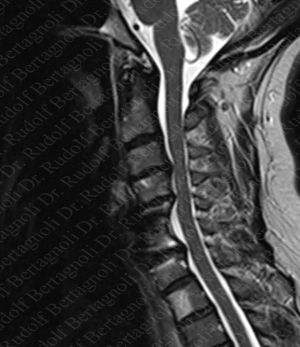 Cervical myelopathy is insidious, because unlike compressed nerves radiating from the spinal cord, the spinal cord feels no pain and it is difficult for patients to say when the symptoms begin. Cervical myelopathy is developed slowly, resulting from a spinal canal stenosis, which is a narrowing of the spinal canal. It is the slow degeneration of the spine called spondylosis, which causes the narrowing of the spinal canal.
Cervical myelopathy begins with compression of the spinal cord in the cervical spine. Edema begins to build about the spinal cord as the cord attempts to protect itself. This edema appears as white in a t2-weighted MRI images.
Early symptoms of cervical myelopathy:
- Heavy feeling in the legs
- Unable to walk at a brisk pace
- Gait disturbance, e.g. bilateral uncertainty when walking blindfolded.
- Deterioration in fine motor skills (such as handwriting or buttoning a shirt)
- Feelings of numbness, tingling, pins and needles, or shooting fire like pain in the arms and/or legs, when bending their head backward or far forward (known as Lermitte’s phenomenon).
- Reduced bladder control, or sexual disturbance, associated with the above.
Spinal nerves inside the spinal cord, which run from the brain to the legs will be affected. Thus these medical signs will become pathological:
- Increased tension in the leg muscles
- (Hyperreflexia) Accentuated reflexes of the knee and ankle
- Forced extension of the ankle may cause the foot to beat up and down rapidly (clonus)
- Stimulating the sole of the foot may cause the big toe to go up (Babinski reflex) instead of down (normal reflex)
- Flicking the middle finger may cause the thumb and index finger to flex (Hoffman’s reflex)
- Compromised coordination may be evidenced by difficulty walking and placing one foot in front of the other (tandem walking).
Traumatic cervical myelopathy with spinal canal stenosis is usually diagnostic at the time of the trauma or is the result of acute disc herniation. The symptoms can be the same as cervical myelopathy caused from degenerative conditions.
Very often artificial disc replacement may be the appropriate surgical solution, particularly if degenerative disc disease is the primary cause.