Dermatome Map
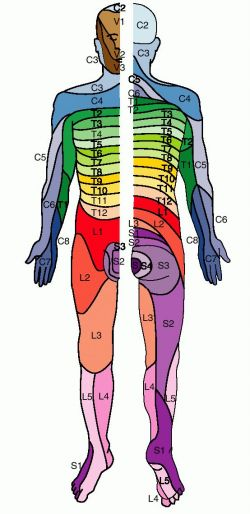
A dermatome is an area of skin supplied by sensory nerve fibers from a single spinal nerve root. The human body has 30 dermatomes, mapped from C2 at the back of the head down to S5 at the perineum. Clinicians use dermatome maps to localize nerve root compression, herniated discs, radiculopathy, shingles, and spinal cord injury levelsDownload Printable Dermatome Chart (PDF)
The dermatome map above shows the correlation between each spinal nerve root and the skin region it supplies with sensation. When a specific dermatome experiences numbness, tingling, burning, or pain, it usually points to compression or irritation of the corresponding nerve root in the spine. Dermatome maps are most useful when interpreted alongside other tests such as MRI, CT, X-ray, EMG, or nerve conduction studies (NCS), and your orthopedic or spine surgeon will determine which additional tests are appropriate.
How to Read a Dermatome Map
Each labeled region corresponds to one spinal nerve root. The labels follow the standard anatomical convention:
- C1–C8 — Cervical (neck) nerve roots, supplying the head, neck, shoulders, arms, and hands
- T1–T12 — Thoracic nerve roots, supplying the chest, upper back, and abdomen
- L1–L5 — Lumbar nerve roots, supplying the lower back, hips, front of the thighs, and inner legs
- S1–S5 — Sacral nerve roots, supplying the back of the legs, feet, buttocks, and perineum
Adjacent dermatomes overlap significantly — a single nerve root injury rarely produces a perfectly bordered area of numbness. This overlap is why physicians look at the pattern of symptoms across multiple dermatomes rather than relying on a single point of complaint.
Cervical Dermatomes (C2–C8)
The cervical dermatomes cover the head, neck, shoulders, and upper limbs. Compression of a cervical nerve root — most often from a herniated disc, bone spur, or foraminal stenosis — produces pain, numbness, or weakness in the corresponding dermatome.
| Nerve Root | Dermatome Area | Common Symptoms of Compression |
| C2 | Back of the head, upper neck | Occipital headache, scalp numbness |
| C3 | Lower neck, upper shoulders | Neck pain, numbness along the collar line |
| C4 | Upper shoulders, top of chest | Shoulder pain, "shoulder cape" numbness |
| C5 | Outer shoulder, upper arm | Shoulder weakness, deltoid pain, biceps weakness |
| C6 | Outer forearm, thumb, index finger | Numbness in the thumb, biceps and wrist extensor weakness |
| C7 | Middle finger, back of forearm | Triceps weakness, middle finger numbness — the most commonly compressed cervical root |
| C8 | Ring and little finger, inner forearm | Hand grip weakness, numbness in the small fingers |
Thoracic Dermatomes (T1–T12)
The thoracic dermatomes wrap around the trunk in horizontal bands from the upper chest to just above the hips. Thoracic radiculopathy is uncommon compared to cervical or lumbar radiculopathy, but thoracic dermatomes are clinically important because they provide reliable anatomical landmarks.
| Nerve Root | Dermatome Area / Landmark |
| T1 | Inner forearm and inner upper arm |
| T2–T3 | Upper chest, axilla |
| T4 | Nipple line |
| T6 | Xiphoid process (lower sternum) |
| T10 | Umbilicus (belly button) |
| T12 | Just above the inguinal ligament / pubic area |
The T4 (nipple), T6 (xiphoid), and T10 (umbilicus) landmarks are widely used to assess sensory levels in suspected spinal cord injury.
Lumbar Dermatomes (L1–L5)
The lumbar dermatomes cover the lower back, hips, front of the thighs, knees, shins, and the top of the foot. Lumbar radiculopathy — most often caused by a herniated lumbar disc — is the most common form of nerve root compression and is what most patients mean when they say "sciatica."
| Nerve Root | Dermatome Area | Common Symptoms of Compression |
| L1 | Groin, very upper thigh | Numbness in the groin, hip flexor weakness |
| L2 | Front of upper thigh | Anterior thigh pain, hip flexor weakness |
| L3 | Front of mid-thigh, inner knee | Knee extensor (quadriceps) weakness, anterior thigh numbness |
| L4 | Inner shin, inner ankle, big toe side of the foot | Quadriceps weakness, diminished knee reflex, numbness over the inner shin |
| L5 | Outer shin, top of foot, big toe | Foot drop, weakness in lifting the big toe, numbness on the top of the foot |
L4–L5 and L5–S1 are the two most common levels of lumbar disc herniation, and the resulting L5 or S1 radiculopathy accounts for the majority of lumbar nerve root compression cases.
Sacral Dermatomes (S1–S5)
The sacral dermatomes cover the back of the legs, the sole and outer edge of the foot, the buttocks, and the perineum.
| Nerve Root | Dermatome Area | Common Symptoms of Compression |
| S1 | Back of the calf, outer edge of the foot, little toe | Calf weakness, diminished ankle reflex, classic sciatica pain pattern |
| S2 | Back of the thigh | Posterior thigh numbness |
| S3–S5 | Perineum, genital region, around the anus | Saddle anesthesia — a red-flag sign for cauda equina syndrome requiring emergency evaluation |
Clinical red flag: Numbness in the saddle region (S3–S5) combined with bowel or bladder dysfunction may indicate cauda equina syndrome. This is a surgical emergency and requires immediate evaluation.
How Dermatome Maps Are Used Clinically
Dermatome maps are one of the foundational tools of neurological examination. In practice, they are used to:
- Localize nerve root compression — matching a patient's pattern of numbness or pain to a specific dermatome helps identify which nerve root is affected, which guides MRI interpretation and surgical planning.
- Distinguish radiculopathy from peripheral neuropathy — peripheral nerve injuries (such as carpal tunnel syndrome) follow peripheral nerve distributions, not dermatomes. The pattern reveals the underlying cause.
- Determine the level of a spinal cord injury — the highest intact sensory dermatome defines the neurological level of injury, which is critical for prognosis and rehabilitation planning.
- Track the distribution of shingles (herpes zoster) — shingles characteristically follows a single dermatome in a band-like pattern on one side of the body.
- Assess recovery after spine surgery — improvement in dermatomal sensation is one of the earliest objective signs of nerve root decompression.
Dermatome vs Myotome — What's the Difference?
A dermatome is the area of skin supplied by a single spinal nerve root for sensation. A myotome is the group of muscles supplied by a single spinal nerve root for movement. Both maps are used together in a neurological exam — dermatomes test sensory function (numbness, tingling), and myotomes test motor function (strength, weakness). When a single nerve root is compressed, you typically see both a dermatomal sensory deficit and a myotomal motor deficit at the same level.
Frequently Asked Questions About Dermatomes
What is a dermatome in simple terms?
A dermatome is a patch of skin connected to a single nerve in your spine. When that nerve is pinched or irritated, you'll usually feel numbness, tingling, or pain in that specific patch of skin. Doctors use dermatome maps to figure out which nerve in the spine is the source of a problem.
How many dermatomes are in the human body?
The human body has 30 dermatomes: 8 cervical (C2–C8, since C1 typically has no skin sensory area), 12 thoracic (T1–T12), 5 lumbar (L1–L5), and 5 sacral (S1–S5).
What dermatome covers the big toe?
The L5 dermatome covers the big toe and the top of the foot. Numbness or weakness affecting the big toe — particularly difficulty lifting it — is a classic sign of L5 nerve root compression, often caused by an L4–L5 disc herniation.
What does the L4 dermatome cover?
The L4 dermatome covers the inner shin, the inner ankle, and the inside of the foot. L4 compression typically causes numbness over the inner shin, weakness of the quadriceps muscle, and a diminished knee-jerk reflex.
What does the C6 dermatome cover?
The C6 dermatome covers the outer forearm, the thumb, and the index finger. C6 radiculopathy commonly produces numbness in the thumb, weakness of the biceps, and weakness of wrist extension.
Why do dermatome maps overlap?
Adjacent spinal nerve roots share some of the same skin territory because each area of skin is innervated by fibers from more than one nerve root. This overlap is why a single nerve root injury rarely produces a perfectly bordered area of complete numbness — symptoms blur into the neighboring dermatomes.
Are dermatome maps the same in every person?
Dermatome maps represent a standardized average. Individual variation does exist, especially at dermatome borders, which is why dermatome findings are interpreted alongside imaging (MRI, CT) and other tests rather than used in isolation.
What is the difference between a dermatome and a peripheral nerve distribution?
A dermatome corresponds to a single spinal nerve root. A peripheral nerve distribution corresponds to a specific peripheral nerve, which is formed by fibers from several spinal nerve roots combined. Carpal tunnel syndrome, for example, follows the peripheral median nerve distribution — not a dermatome.
Can a dermatome map diagnose a herniated disc?
A dermatome map cannot diagnose a herniated disc on its own, but it strongly suggests which level of the spine is involved. The map narrows the search; an MRI confirms it. Together they guide whether conservative treatment, injection, or surgery is appropriate.
Is shingles related to dermatomes?
Yes. Shingles (herpes zoster) erupts along a single dermatome on one side of the body, producing the characteristic band-like rash. The dermatomal pattern is one of the most reliable diagnostic signs of shingles.
Related Information
- Artificial Disc Replacement
- Interlaminar Decompression
- Dynamic Stabilization
- Autofusion of the Spine
- About Prof. Dr. Bertagnoli